MLB Players Betting: Scandals, Integrity Rules, and Prop Bets
 Available in US
Table of Contents
- MLB Betting Metrics: Key Numbers Defining Baseball Wagering
- Why “MLB Players Betting” Means Two Very Different Things in 2026
- From Black Sox to Clase: A Century of Players Who Gambled
- How MLB Monitors Every Suspicious Wager
- MLB Player Props: Strikeouts, Home Runs, and the Markets That Fuel the Scandal
- Moneyline, Run Line, Over/Under: Core MLB Bet Types Explained
- The Legal Landscape: PASPA Repeal, State Expansion, and Congressional Scrutiny
- Responsible Gambling: What the Data Says About Betting Harm
- Finding Edge in MLB Betting: EV, Park Factors, and Sharp Thinking
- What Comes Next for MLB and Sports Betting
- FAQ
By MLB Betting Integrity Analyst

MLB Betting Metrics: Key Numbers Defining Baseball Wagering
- UK legal sports betting handle reached £166.94 billion in 2025, with sportsbooks keeping a record 9.7 percent win rate — the house edge is growing, not shrinking.
- At least 20 professional athletes across five major leagues have been disciplined for gambling violations since the 2018 PASPA repeal. Five are MLB-connected.
- Pitch-level micro-bets enabled the Clase scheme. MLB has since capped them at £158 and banned them from parlays across 98 percent of the market.
- Up to 16 percent of online bettors show signs of gambling disorder. The average problem-gambling debt before seeking help: £21,725.
- Ohio’s proposed Save Ohio Sports Act would ban online betting, props, and parlays entirely — a legislative signal that expansion is no longer guaranteed.
Why “MLB Players Betting” Means Two Very Different Things in 2026
I typed “mlb players betting” into a search bar last week and watched two entirely separate worlds collide on the same results page. Half the links wanted to sell me strikeout props for tonight’s slate. The other half wanted to tell me about a federal indictment. That collision — entertainment product meets criminal probe — is the story of baseball and gambling right now, and it is the reason this guide exists.
The phrase carries a double meaning that would have been impossible a decade ago. “MLB players betting” can describe millions of fans placing legal wagers on player performance every night of a 162-game season. Or it can describe the players themselves — professionals who risked careers, reputations, and in the case of Emmanuel Clase, their freedom — by gambling on the sport they play. Both meanings are surging in relevance at the same time, which is not a coincidence. The legal UK sports betting handle hit £166.94 billion in 2025, an 11 percent jump over the prior year. The more money that flows through sportsbooks, the more pressure points exist for manipulation, the more scandals surface, and the more urgent it becomes to understand the full picture.
Since the Supreme Court struck down the sports betting ban in 2018, at least 20 professional athletes across the five major professional leagues have been disciplined for gambling violations. More than a quarter of those cases involve baseball. The sport that invented the lifetime ban — a full century ago, in response to the Black Sox — is still fighting the same battle, only now the stakes are measured in billions rather than thousands.
This guide covers both sides of “MLB players betting.” I will walk through the scandal timeline from 1919 to the Clase indictment, explain how MLB’s integrity monitoring actually works (and where it failed), break down the prop bet markets that attract both fans and fixers, lay out the core bet types every baseball bettor should understand, map the regulatory landscape across all legal jurisdictions, confront the problem-gambling data the industry prefers to ignore, and outline what a responsible, edge-aware approach to MLB wagering looks like. If you are here for picks and odds, you will find the analytical framework behind them. If you are here because a headline about a pitcher rigging throws caught your attention, you will find the full context.
I have spent over nine years covering the intersection of baseball analytics, wagering strategy, and gambling regulation. What strikes me most about this moment is the speed. The market grew faster than the safeguards, the scandals arrived faster than the reforms, and the legislative response is still catching up to both. Understanding all of it — not just the piece that interests you today — is no longer optional if you engage with MLB betting in any capacity.
Two meanings, one search query, and a sport that cannot decide whether gambling is its greatest threat or its most lucrative partner. Let’s start with the threat.
From Black Sox to Clase: A Century of Players Who Gambled
The first thing I tell anyone new to baseball’s gambling history is this: the sport did not stumble into an integrity crisis. It was born in one. The 1919 World Series fix involving eight Chicago White Sox players was not just a scandal — it was the event that created the office of the Commissioner of Baseball. Every rule, every investigation, every lifetime ban that followed traces back to that October, when a group of underpaid players took money from gamblers to lose on purpose.
What makes the Black Sox case relevant today is not the historical drama. It is the structural lesson. Commissioner Kenesaw Mountain Landis banned all eight players for life, even those acquitted at trial, establishing a principle that baseball’s internal punishment would be harsher and swifter than anything the courts delivered. That principle held for a century. Pete Rose accepted permanent ineligibility in 1989 rather than face the full findings of the Dowd Report. He spent 35 years petitioning for reinstatement and never received it. In May 2025, Commissioner Rob Manfred amended the rules so that a lifetime ban now expires upon the banned person’s death — a change that led to the posthumous restoration of several Black Sox-era players but arrived too late for Rose, who died in September 2024.

| Then: 1919-1989 | Now: 2024-2026 |
|---|---|
| Players fixed game outcomes for cash payments from outside gamblers | Players exploit legal micro-bet markets by manipulating individual pitches |
| Detection relied on tips, journalistic investigation, and circumstantial evidence | Detection relies on algorithmic monitoring of real-time betting data across dozens of operators |
| Punishment was internal: Commissioner’s authority, no federal charges | Punishment now includes federal prosecution under wire fraud and conspiracy statutes |
| Illegal bookmakers handled all wagers | Legal, regulated sportsbooks process over £131 billion in annual handle |
The modern era of MLB gambling violations arrived in 2024 with Tucupita Marcano. He placed 387 bets on baseball — including games involving his own team — through a legal sportsbook between October 2022 and November 2023, wagering over £118,500. His win rate on MLB-related bets was 4.3 percent. That number still astonishes me: the man was not a sophisticated operator exploiting insider knowledge. He was a compulsive bettor who happened to be a professional ballplayer, and the sportsbook’s own data made the case against him. MLB banned Marcano for life, the first post-PASPA lifetime ban in baseball.
Then came the case that shifted everything. In 2025, federal prosecutors indicted Cleveland Guardians closer Emmanuel Clase — a three-time All-Star earning £3.6 million per year on a £15.8 million contract — for allegedly helping co-conspirators win at least £316,000 in fraudulent pitch-level bets between May 2023 and June 2025. His teammate Luis Ortiz was charged in a related scheme involving £47,400 in rigged wagers on just two intentionally thrown balls. The Clase indictment was not about a player betting on games. It was about a player deliberately altering his on-field performance to trigger specific micro-bet outcomes — a form of corruption that the old rules were never designed to catch.
Senators Ted Cruz and Maria Cantwell, leading the Senate Commerce Committee, put it bluntly in their letter to Commissioner Manfred: they called the situation a “new integrity crisis” and asked how MLB caught Marcano and banned him for life but failed to notice Clase allegedly rigging pitches for two years. That question — the gap between detection capability and detection reality — runs through every section of this guide.
Between the Black Sox ban of 1920 and the Marcano ban of 2024, only one MLB player — Pete Rose — received a lifetime gambling ban. In the two years since PASPA-era enforcement began, five MLB-connected individuals have been disciplined for gambling violations. The full MLB betting scandal timeline covers every case from the 1919 fix through the 2025 federal indictments.
How MLB Monitors Every Suspicious Wager
A compliance officer at a major sportsbook once told me that monitoring baseball betting is like watching 2,430 regular-season games through a keyhole — you see every data point, but context is everything. The system MLB relies on has three distinct layers, and understanding where each one operates (and where it goes blind) matters whether you are a bettor, a fan, or a regulator.
The Three Monitoring Layers: First, sportsbook operators themselves flag unusual wagering patterns — a sudden spike in volume on a specific pitch outcome, for instance, or a cluster of maximum-stake bets placed within seconds of each other from accounts linked by geography or device. Second, third-party surveillance firms like Sportradar and its Integrity Services division aggregate data across operators, looking for cross-platform anomalies that no single sportsbook can see in isolation. Third, MLB’s own Department of Investigations — staffed with former federal agents — conducts proactive inquiries and receives referrals from both the first and second layers.
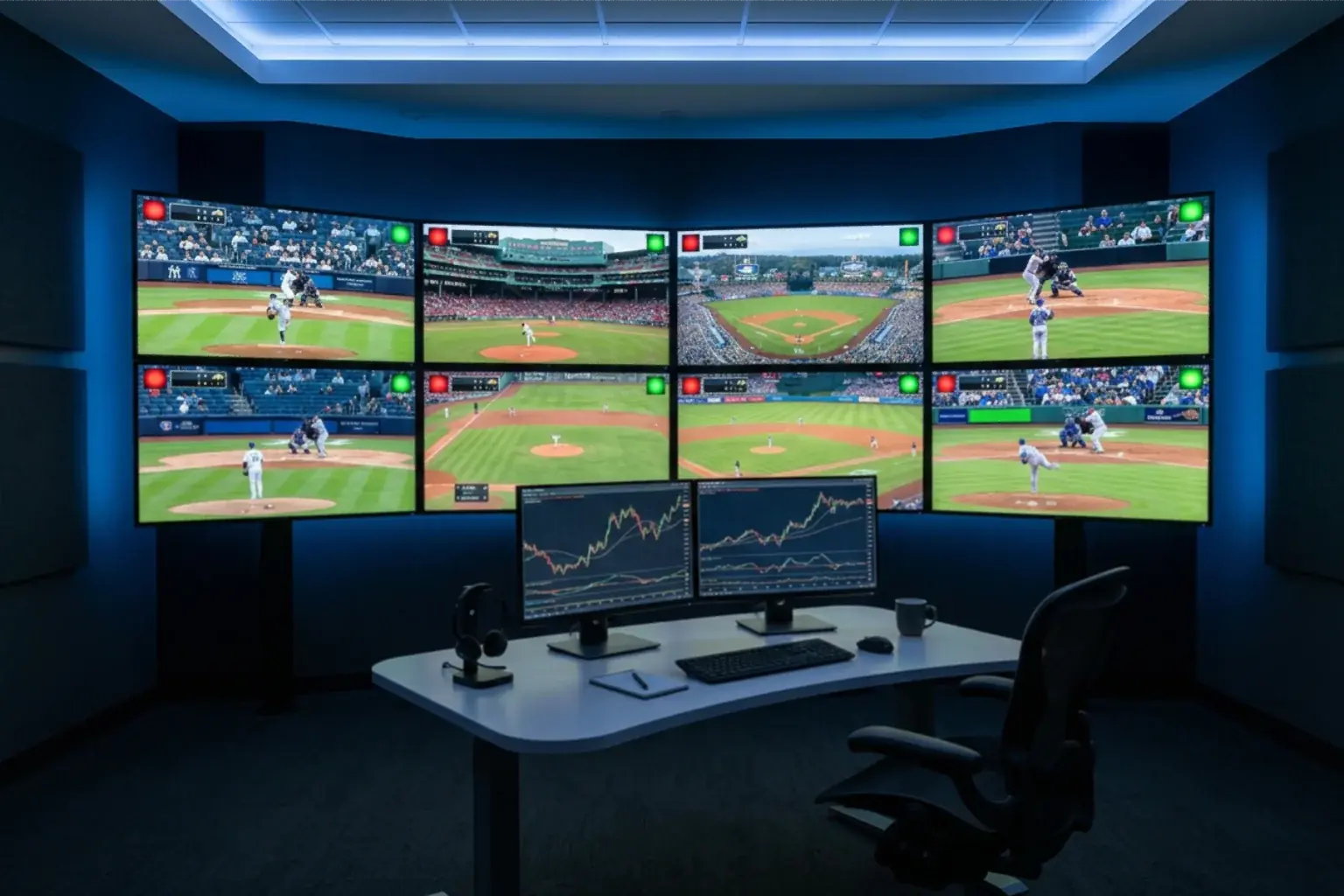
Commissioner Manfred has been candid about the logic behind this architecture. He has acknowledged that legalisation makes monitoring far easier than the old illegal market, and that the crucial issue is access to data — which requires a relationship with the sportsbooks. That relationship is real: MLB has official data partnerships with multiple operators, feeding real-time game data into betting platforms. The same pipeline that powers your live odds also feeds the integrity alerts.
98%
Share of the betting market covered by operators that adopted MLB’s post-Clase micro-bet restrictions
90%
Percentage of modern sports wagers placed via mobile devices, with over half occurring live during games
20+
Professional athletes disciplined for gambling violations across five major professional leagues since the 2018 PASPA repeal
The system works well for detecting the Marcano type of violation: a player betting through his own verified sportsbook account, generating a digital trail that is essentially self-incriminating. But the Clase case exposed a different vulnerability entirely. Pitch-level micro-bets — wagers on whether a single pitch will be a ball or strike, or whether the next delivery will exceed a certain velocity — create a market so granular that a single player can influence the outcome without any coordination with teammates. The alleged scheme did not require Clase to lose a game. It required him to throw a specific type of pitch at a specific moment, which would look unremarkable in isolation. The co-conspirators placed the bets, not the player, making the digital trail harder to follow.
For a deeper look at the detection architecture, its known blind spots, and the reforms implemented after the Clase indictment, I have written a dedicated breakdown of MLB’s integrity monitoring system. The short version: the technology is genuinely sophisticated, but it was designed for a world where the primary threat was players betting on game outcomes, not players subtly manipulating pitch-by-pitch micro-markets that did not exist five years ago.
MLB Player Props: Strikeouts, Home Runs, and the Markets That Fuel the Scandal
I remember the first time I placed a strikeout prop. It was 2019, the market was thin, the lines were soft, and nobody at the bar cared what I was doing on my phone. Fast-forward to now, and player props are the fastest-growing segment of MLB wagering. Ninety percent of all sports bets are placed on mobile devices, with more than half occurring live during games — and prop markets are the engine driving that growth. They are also, as the Clase case demonstrated, the markets most vulnerable to manipulation.
Handle — the total amount of money wagered on a given market or across a sportsbook’s entire operation. Not to be confused with revenue or profit; handle includes all money that is returned to winning bettors.

Vig (or juice) — the commission a sportsbook charges on every bet. On a standard -110/-110 line, the bettor risks £86.9 to win £79. The £7.9 difference is the vig. It is the reason sportsbooks are profitable even when they get outcomes wrong.
Handle vs. GGR — Gross Gaming Revenue (GGR) is what sportsbooks keep after paying out winners. In 2025, the sports betting industry generated £13.40 billion in GGR from £132.00 billion in handle, meaning the average sportsbook kept about 10 pence of every pound wagered.
Player proposition bets — props — allow you to wager on an individual player’s statistical performance rather than the game’s outcome. The most common MLB props are pitcher strikeout totals (over/under a set number), batter home runs (to hit one: yes or no), hits, total bases, and walks. These markets appeal to bettors because they feel researchable: you can study a pitcher’s strikeout rate against left-handed hitters, check the park’s dimensions, factor in the weather, and arrive at an opinion that feels more grounded than picking which team will win.
That feeling of control is both the appeal and the trap. Sports agent Scott Boras captured the integrity dimension when he said that a pitcher overthrows a ball and it sails 55 feet, and now you wonder. He argued that removing prop bets is the only way to stop the integrity of players from being questioned every time something looks off on the mound. Whether you agree with Boras or not, the concern is not hypothetical. The Clase indictment alleges that co-conspirators won at least £316,000 by betting on pitch outcomes that the pitcher himself controlled.
For bettors, the practical question is how to engage with prop markets responsibly and analytically. The player props strategy guide covers evaluation frameworks in depth — strikeout line analysis, park factor adjustments, platoon splits, and expected value calculations. Here, I will focus on the structural features that make props both attractive and risky.
Props carry higher vig than game-level markets. A standard moneyline might have a total hold of 3-4 percent; a strikeout prop line can carry 6-8 percent or more, depending on the operator. That means you need to be right more often just to break even. The average annual sportsbook win rate reached a record 9.7 percent in 2025, and prop markets are a significant contributor to that margin. When you see a line of -120 on a strikeout over, the sportsbook is not just offering you a number. It is pricing in its edge, its model’s confidence, and the vig — and you are betting against all three.
| Pitcher Strikeout Prop | Over 6.5 | Under 6.5 |
|---|---|---|
| Line (hypothetical) | -125 | +105 |
| Implied probability | 55.6% | 48.8% |
| Combined implied probability | 104.4% (the 4.4% excess is the vig) | |
The other structural reality is correlation. Prop outcomes are not independent events. A pitcher who throws seven scoreless innings will likely accumulate strikeouts while also contributing to a “no run first inning” (NRFI) outcome and suppressing the game total. Sportsbooks account for this when building same-game parlays, adjusting the combined odds to reflect correlations — but the adjustments are opaque, and bettors rarely know how much extra edge the operator is taking. This is why I always evaluate props individually before even considering combining them.
Pitch-Level Micro-Bets and Why MLB Capped Them
After the Clase and Ortiz indictments, MLB moved to restrict pitch-level wagers across the entire legal market. Operators covering 98 percent of sports betting volume agreed to cap individual pitch-level bets at £158 and exclude them from parlays. Commissioner Manfred publicly commended Ohio Governor Mike DeWine for his leadership on the issue and called the restrictions a national solution to address the risks posed by these markets.
Micro-bets — wagers resolved on a single pitch, such as ball or strike, pitch velocity over/under, or next pitch type — are the most granular market in all of sports betting. They are also the most exploitable. A single player can determine the outcome without any teammate’s involvement, without altering the game’s final score, and without doing anything that looks obviously wrong on a broadcast. Throwing a fastball instead of a slider on a 2-1 count is a normal baseball decision. If someone with advance knowledge of that decision has placed a £158 bet at the right odds across multiple accounts, the payout can be meaningful — and the evidence trail is minimal.
The £158 cap and parlay exclusion do not eliminate the risk. They reduce the financial incentive for any single wager, but they do not address coordinated betting across multiple accounts, jurisdictions, or platforms. What the cap does accomplish is making it economically impractical to generate the kind of returns alleged in the Clase scheme — £316,000 over two years — without placing enough volume to trigger monitoring alerts. It is a pragmatic compression of the opportunity window, not a closure.
The broader question is whether pitch-level markets should exist at all. Boras says remove them entirely. The sportsbook industry argues they drive engagement and that the vast majority of micro-bettors are recreational users posing no integrity risk. I sit somewhere in between: the markets are here, the demand is real, but the regulatory framework has not caught up to the speed at which they can be exploited. Until it does, the cap is a necessary but insufficient fix.
Moneyline, Run Line, Over/Under: Core MLB Bet Types Explained
Before I ever looked at a prop market, I spent two full seasons betting nothing but moneylines. It taught me something that flashier markets tend to obscure: the fundamentals of how odds work, what you are actually paying for each bet, and where the sportsbook’s margin hides. If you are newer to baseball betting, this is where to anchor yourself. If you are experienced, skim it — but consider whether you have ever calculated the true cost of your average bet, because most people I talk to have not.
Baseball offers three primary game-level markets, and they behave differently from what you might know in football or basketball.
Moneyline is the simplest: pick the winner. No point spread, no run margin. Because baseball is a low-scoring sport with frequent upsets, moneyline odds tend to be tighter than in other major leagues. A typical line might show the favorite at -145 and the underdog at +125. That means risking £115 to win £79 on the favorite, or risking £79 to win £98.8 on the underdog. The gap between those two numbers is where the sportsbook earns its margin.
| Favourite | Underdog | |
|---|---|---|
| Moneyline (hypothetical) | -145 | +125 |
| Implied win probability | 59.2% | 44.4% |
| Combined probability | 103.6% (3.6% is the vig) | |
Run Line — baseball’s version of the point spread, fixed at 1.5 runs. The favorite must win by two or more runs to cover -1.5; the underdog covers +1.5 by winning outright or losing by exactly one run.
The run line is fixed at 1.5 runs in standard markets, which creates a fundamentally different risk profile from football spreads that shift with each game. At -1.5, you are betting the favorite wins by at least two runs. The payout is better than the moneyline because the condition is harder to meet. At +1.5, you are betting the underdog either wins outright or loses by a single run — a softer cushion that comes at a steeper price. Alternate run lines at -2.5 or +2.5 exist for bettors who want to push the math further in either direction.
The over/under (totals) market asks whether the combined runs scored by both teams will exceed or fall short of a set number, typically between 7 and 9.5 depending on the pitching matchup, park, and weather. Totals betting forces you to think about both offences and both pitching staffs simultaneously, which is why it rewards the kind of granular analysis that sabermetrics provides — park factor data, bullpen usage patterns, wind direction at first pitch.
The record sportsbook win rate of 9.7 percent in 2025 tells you something important about all three markets: the house edge is real, it is growing, and it compounds over volume. Every bet you place, regardless of type, carries an embedded cost. Understanding that cost — and choosing the market where your analytical edge is largest relative to it — is the most fundamental skill in baseball wagering.
The Legal Landscape: PASPA Repeal, State Expansion, and Congressional Scrutiny
When the Supreme Court struck down the Professional and Amateur Sports Protection Act in May 2018, Commissioner Manfred admitted something unusually candid for a league executive. He acknowledged that MLB had been dragged into legalised sports betting as a litigant, but recognised that legalisation made monitoring far easier than policing an illegal market ever could. That pragmatic pivot — from opponent to reluctant participant to active commercial partner — defines baseball’s current position in the regulatory landscape.
£474B+

Total legally wagered on sports since the 2018 PASPA repeal
39 states + DC
Jurisdictions where some form of sports betting is now legal
31 states + DC
Jurisdictions permitting online sports wagering as of December 2025
£2.93B
Total tax revenue from sports betting in 2025, up 32.4% year-on-year
The expansion has been staggering by any historical measure. More than £474 billion has been legally wagered on sports since PASPA fell. All major jurisdictions and Washington, D.C. have legalised some form of sports betting, with 31 jurisdictions allowing online wagering. New York alone processed £20.5 billion in handle in 2025 — roughly 16 percent of the national total — while Ohio crossed the £7.9 billion mark. State tax revenues from sports betting hit £2.93 billion in 2025, a 32.4 percent increase over the prior year. The Office for National Statistics tracked a 382 percent rise in jurisdiction-level gambling tax collections between the third quarter of 2021 and the second quarter of 2025. For a full breakdown of handle, GGR, and jurisdiction-by-jurisdiction revenue data, see the MLB betting market size analysis.
Why tax rates matter for bettors: State tax rates on sportsbook revenue range from 6.75 percent in Iowa and Nevada to 51 percent in New Hampshire, New York, and Rhode Island. Higher tax rates can reduce the promotional offers and bonus credits operators make available, because those costs eat into taxable revenue. The state you bet in affects not just legality but the competitiveness of the odds you receive.
But the political mood is shifting. In November 2025, the Senate Commerce Committee — led by Ted Cruz and Maria Cantwell — launched an investigation into MLB’s betting integrity, citing the Clase and Ortiz cases as evidence of what they termed a systemic vulnerability across multiple leagues. The probe is examining how effectively leagues monitor their own integrity, whether sportsbook partnerships create conflicts of interest, and whether federal legislation is needed to supplement the current jurisdiction-by-jurisdiction patchwork.
At the state level, the backlash is even more concrete. In April 2026, Ohio legislators introduced the Save Ohio Sports Act, proposing to ban online sports betting, prop bets, parlays, and wagers on collegiate athletics entirely. The bill would cap individual bets at £79 and limit bettors to eight wagers per day. Ohio Governor Mike DeWine, who has been vocal about athlete harassment and the two Cleveland-based indictments, called the evidence that prop betting is harming athletics in Ohio “reaching critical mass.” Whether the bill passes or not, it signals a political environment where the expansion of legal betting is no longer assumed to be irreversible.
The regulatory landscape is not a settled map. It is a moving negotiation between revenue departments that depend on the tax pounds, leagues that profit from data partnerships while enforcing integrity rules, sportsbook operators that drive the market, and a growing coalition of legislators, public health advocates, and sports figures who argue the whole thing moved too fast.
Responsible Gambling: What the Data Says About Betting Harm
I have written about betting strategy for years, and the question I get most often from readers is not about strikeout props or closing line value. It is: “Am I betting too much?” That question deserves a straight answer, and the data available in 2025-2026 provides one that the industry would rather not amplify.
Up to 16 percent of online sports bettors display signs of gambling disorder, with an additional 13 percent showing subclinical symptoms. One in four bettors has missed a bill payment because of wagering. One in five people with a gambling disorder attempts or completes suicide — a rate higher than for most other addictions.

Cait Huble, Director of Public Affairs at the National Council on Problem Gambling, described the current environment as the largest and fastest explosion of gambling the country has ever seen, and warned that public understanding of gambling harm lags a decade behind other addictions. The numbers bear her out. Roughly 22 percent of adults — and 48 percent of men aged 18-49 — now hold at least one account with an online sportsbook. The average debt a problem gambler carries before seeking help is approximately £21,725. That figure has risen alongside the market’s growth, and it lands hardest on the demographic most likely to be betting on MLB props on a Tuesday night.
There is a statistic I think about often when writing about sharp strategy and EV models: a study of nine million bettors during the 2023-2024 NFL season found that 60 percent of bettors generated just 1 percent of sportsbook revenue. The other 40 percent — the heavy users — produced virtually all of the industry’s profit. That distribution is not unique to football. It describes a market where the majority of participants are recreational and the business model depends on a smaller population that bets far more than the median.
Baseball’s 162-game season makes the volume dynamic particularly relevant. A football bettor might engage with 17 regular-season games plus playoffs. A baseball bettor can wager on games nearly every day for six months. Prop markets multiply the opportunities within each game. The structure of the sport — long season, daily games, granular stats — creates more access points for both informed wagering and compulsive behavior. I am not suggesting that everyone who bets on baseball is at risk. I am saying that the sport’s structure demands more self-awareness than most bettors bring to it.
If you find yourself chasing losses across a Tuesday afternoon slate, or if the thought of not betting on tonight’s game produces anxiety rather than indifference, those are signals worth paying attention to. GambleAware operates a freephone helpline (0808 8020 133) and live chat service around the clock, and GamStop allows you to self-exclude from all UK-licensed gambling sites. Using them is not a sign of weakness; it is the sharpest move a bettor can make.
Finding Edge in MLB Betting: EV, Park Factors, and Sharp Thinking
Let me share the moment that changed how I think about baseball betting. It was 2021, and I had been tracking my results with the discipline of someone who genuinely believed he was profitable. Then I ran the numbers against the closing line — the final odds posted just before first pitch — and discovered that I was beating my own opening-line entries but consistently losing to the close. In other words, I was identifying value that the market corrected away before the game started. I was not sharp. I was just early.
That experience taught me the single most important concept in betting: expected value (EV). A bet has positive expected value when the probability you assign to an outcome is higher than the probability implied by the odds. The formula itself is straightforward — (probability of winning x payout) minus (probability of losing x stake) — but applying it honestly requires two things most bettors lack: a reliable model for estimating true probabilities, and the emotional discipline to trust the model when it disagrees with your gut.
Why the sportsbook win rate matters to you: The average annual sportsbook win rate reached a record 9.7 percent in 2025. That means for every £79 wagered across the market, bettors collectively lost £7.66. Your personal task, if you aim to be profitable, is to overcome that margin through superior probability estimation — consistently, across hundreds of bets, over months.
Baseball is uniquely suited to quantitative modelling because the sport generates more measurable, repeatable individual matchups than any other. Every plate appearance is a discrete event with extensive historical data: pitcher velocity, spin rate, release point, batter launch angle, park dimensions, altitude, humidity, plate umpire strike zone tendencies, catcher framing metrics. Projection systems ingest these inputs and generate expected outcomes — projected strikeout rates, home run probabilities, run totals — that can be compared against the lines sportsbooks post.
The comparison between your projected probability and the line’s implied probability is where edge lives. If your model says a pitcher has a 58 percent chance of going over 6.5 strikeouts and the line implies 53 percent (roughly -113), you have identified a potential +EV spot. Whether that edge is real depends on the quality of your model. Whether it survives long-term depends on the volume of bets you place and the variance you can absorb.
Closing line value is the standard test for whether an edge is real. What the standard rarely states is where the bar sits: you have to beat the close by more than the market’s own margin before any of it reaches your bankroll.
| Market | Typical margin | CLV needed | ROI at your CLV | Season |
|---|---|---|---|---|
| Sharp moneyline, low hold | 2,0 % | 2,00 % | +2,33 % | +£140 |
| Standard MLB moneyline | 3,6 % | 3,60 % | +0,74 % | +£45 |
| Strikeout prop, tight | 4,4 % | 4,40 % | −0,03 % | −£2 |
| Strikeout prop, typical | 7,0 % | 7,00 % | −2,46 % | −£147 |
| Micro-bet or exotic | 10,0 % | 10,00 % | −5,12 % | −£307 |
The logic is short. A closing price contains the market’s best estimate plus its margin, so stripping the margin out gives the true probability. Your expected return is then that probability multiplied by the price you actually took. Written out, the return equals one plus your closing line value, divided by one plus the margin, minus one — which means the break-even point is not zero CLV but CLV equal to the margin. The table shows why that distinction is not academic. The same three percent of closing line value that turns a profit on a sharp moneyline loses money on a strikeout prop, purely because the props market charges roughly twice the hold. That sharpens the advice given elsewhere in this guide about props carrying 6 to 8 percent against 3 to 4 on game markets: it is not simply that props are more expensive, it is that they raise the standard of proof your handicapping has to meet. An edge worth acting on in one market is worth ignoring in the other. There is a second implication for the tracking habit recommended above. Recording closing line value is the right instinct, but recording it without also recording the market’s margin produces a number that cannot be interpreted. A spreadsheet column showing plus three percent CLV across a season means nothing until you know whether those bets were struck into two percent markets or ten. Add the margin column and the same log becomes readable. One caveat on the model: it assumes the closing line is efficient once de-vigged, which is the standard assumption but not a proven one, and it assumes the margin is split evenly across both sides of the market. Where a book shades one side deliberately, the true probability behind the close sits somewhere other than this calculation puts it. More in the guides to expected value on props, reading line movement and player props strategy. 18+; GambleAware and the National Gambling Helpline on 0808 8020 133.
Pre-Bet Analytical Checklist
- Identify the market: moneyline, run line, total, or prop. Know the vig embedded in the line.
- Estimate true probability using at least one projection system or your own model. Do not rely solely on recent form or narrative.
- Compare your probability to the implied probability of the posted odds. If your edge is less than 2-3 percent, the vig likely erases it.
- Check for park, weather, and umpire factors that your model may not fully capture. Coors Field and Tropicana Field warp the numbers.
- Set stake size relative to your bankroll and edge size. Flat-betting 1-2 percent of bankroll per wager is a reasonable baseline for most bettors.
- Record the bet, your estimated probability, and the closing line. Review weekly, not game-by-game.
I mentioned earlier that the vast majority of bettors generate a tiny fraction of sportsbook revenue. The corollary is that most people who believe they are beating the market are not — they are simply experiencing normal variance on a small sample. The strategy question is not just "how do I win?" — it is "which group am I actually in, and am I honest about the answer?" Tracking your results against the closing line, over hundreds of bets, is the only reliable way to find out. If you are consistently beating the close, you have edge. If you are not, you are paying for entertainment — and there is nothing wrong with that, as long as you know the price.
What Comes Next for MLB and Sports Betting
The next 18 months will determine whether the current regulatory patchwork holds or whether something more dramatic replaces it. Three forces are converging, and each one pulls in a different direction.
The first is legislative. Ohio's Save Ohio Sports Act, introduced in April 2026, proposes restrictions so severe — banning online betting, prop bets, parlays, and collegiate wagers, capping stakes at £79, limiting bettors to eight wagers per day — that if passed, it would effectively dismantle the state's £7.9 billion-plus betting market. Ohio generated over £0.79 billion in sportsbook revenue in 2025, with 98 percent coming from online channels. Whether the bill succeeds or fails, it establishes a template for other jurisdictions where gambling-related harm, athlete harassment, or high-profile scandals have shifted the political calculus. The Senate Commerce Committee's ongoing investigation adds federal pressure to the jurisdiction-level momentum.
The second force is technological. Sportsbooks are expanding micro-bet offerings into new sports, new granularities, and new in-play formats. The pitch-level cap in baseball is a containment measure, not a trend reversal. Michal Lorenc, a Clinical Assistant Professor of Sport Management at the University of Michigan, has predicted that sports betting is here to stay and that over the next few years a number of changes and adjustments to betting policies and practices will emerge, with some rules likely to be relaxed. That prediction reflects the industry's trajectory: more markets, more speed, more data, more engagement — and more integrity surface area to monitor.
The third force is cultural. The normalization of sports betting among younger demographics is producing a generation of fans for whom wagering is not a separate activity from watching — it is the activity. Twenty-four percent of male college athletes surveyed by the NCAA in 2024 reported betting on sports for money in the previous year. Those athletes are the future MLB players, coaches, and front-office staff who will inherit whatever integrity framework the league builds now.
The tension at the heart of MLB betting is not going away. The league profits from sportsbook partnerships while punishing players who engage with the same industry. States collect billions in tax revenue while proposing bans on the markets that generate it. Bettors have more analytical tools than ever while the sportsbook win rate keeps climbing. Navigating this landscape requires understanding all of these dynamics — not just the one that matters to you tonight.
FAQ
What happens when an MLB player is caught betting on games?
The consequences depend on what the player bet on. Under MLB's Rule 21, a player who bets on any MLB game faces a one-year suspension. A player who bets on a game involving their own team faces permanent ineligibility — a lifetime ban. If the conduct also violates federal law, as in the Clase case, criminal prosecution can run in parallel. The player is typically placed on administrative leave immediately, loses access to team facilities, and forfeits salary for the duration of the suspension or ban. Reinstatement after a lifetime ban requires a formal application to the Commissioner, and historically, no player has been successfully reinstated during their lifetime.
What is MLB Rule 21 and how does it apply to gambling?
Rule 21 is baseball's core anti-gambling statute, posted in every professional clubhouse since the 1920s. It prohibits players, coaches, umpires, and club employees from betting on baseball games and establishes a tiered penalty system: one-year suspension for betting on games not involving one's own team, and permanent ineligibility for betting on one's own team or for any involvement in game-fixing. The rule was amended in May 2025 so that a lifetime ban now expires upon the banned person's death, enabling posthumous reinstatement. Rule 21 does not explicitly address all forms of legal sportsbook use for non-baseball events, which creates gray areas that MLB is still navigating.
Which MLB players have been banned for gambling?
The most significant bans include the eight Black Sox players permanently banned in 1920, Pete Rose who accepted permanent ineligibility in 1989, and Tucupita Marcano who was banned for life in 2024 after placing 387 baseball bets totaling over £118,500. Emmanuel Clase and Luis Ortiz were charged federally in 2025 for an alleged pitch-fixing scheme and face both league discipline and criminal prosecution. Several other players and personnel have received one-year suspensions for lesser violations since the PASPA repeal. In total, at least five MLB-connected individuals have been disciplined for gambling infractions in the post-2018 era.
How do micro-bets and pitch-level props create integrity risks in baseball?
Pitch-level bets — wagers on whether a single pitch will be a ball or strike, or on its velocity and type — allow a single player to influence the outcome without any teammate's cooperation and without altering the game's result. A pitcher can throw a specific pitch at a specific moment as a normal baseball decision, while a co-conspirator bets on that exact outcome. This makes manipulation harder to detect than traditional game-fixing. After the Clase indictment, MLB worked with operators covering 98 percent of the market to cap pitch-level bets at £158 and exclude them from parlays, reducing the financial incentive for schemes of this type.
What is the difference between MLB moneyline, run line, and over/under bets?
The moneyline is a straight pick on which team wins — no point spread, no margin required. The run line is baseball's spread bet, fixed at 1.5 runs: the favorite must win by two or more runs at -1.5, while the underdog covers at +1.5 by winning outright or losing by one. The over/under (totals) asks whether the combined runs scored by both teams will exceed or fall below a set number, typically 7 to 9.5. Moneylines are the most straightforward entry point; run lines offer better payouts at higher risk; and totals reward analysis of pitching matchups, park dimensions, and weather conditions.
How does MLB monitor suspicious betting activity?
MLB uses a three-layer system. Sportsbook operators flag unusual patterns at the account level. Third-party surveillance firms like Sportradar aggregate data across platforms to detect cross-operator anomalies. MLB's own Department of Investigations — staffed with former federal agents — conducts proactive inquiries and receives referrals from both layers. The system detected the Marcano case effectively because the player bet through his own verified account. The Clase case exposed the system's limitations: pitch-level manipulation by a player who was not placing the bets himself evaded detection for approximately two years.
Can MLB players bet on other sports legally?
Rule 21 specifically prohibits betting on baseball. The rule's text does not impose a blanket ban on all sports betting for players, but MLB's internal policies and the collective bargaining agreement add restrictions beyond what Rule 21's posted language covers. In practice, players are strongly discouraged from using sportsbook apps, and any betting activity — even on non-baseball events — that comes to the league's attention could trigger an investigation. The gray area between the letter of Rule 21 and the broader conduct expectations is one of the most debated aspects of the current policy framework.
Created by the ”mlb Players Betting” editorial team.